The north of England is truly the birthplace of Quakerism, and Yorkshire stands at the heart of its history. It was here that George Fox (1624-1691), the visionary founder of the movement, first spread his message, and it was from this very region that the early converts—known as the ‘First Publishers of Truth’—carried that message far and wide. Yorkshire also witnessed the formation of the first Quaker Meetings and was the birthplace of the early organizational structures and principles that would shape the Quaker movement.
In the 16th and 17th centuries Hull, like many other towns, was a place of some religious turbulence. A Friends Meeting in Hull was initiated by Richard Emmerson and John Holmes who were influenced by the East Riding preaching of William Dewsbury. The establishment of the Meeting was given a boost by the visits of George Fox in 1652 (after he’d slept the previous night under a haystack), 1658 and 1666. The Meeting was established about 1660.
As was their fate the Quakers were soon persecuted particularly by officers of Hull’s Garrison and meetings were broken up and people snatched from the street as well as, incredibly, from their own houses. In 1660 six Quakers were imprisoned on return from their expulsion from Hull but following the Act of Tolerance in 1689 the group were left alone to worship as they pleased.
'Truly Friends in the North is rare and precious, very few I find like them,' wrote Richard Roper to Margaret Fell in October 1656 [Swarthmore collection, iii 131, Friends House Library]. By the end of 1653, key regions of Quaker conversion included Westmorland, Cumberland, north Lancashire, Durham, and of course, Yorkshire.
Between 1651 and 1652, George Fox embarked on a transformative journey across the North and East Ridings of Yorkshire. His travels then took him into north Lincolnshire and through the bustling towns of Wakefield and Bradford. One of the earliest groups of devoted Quakers, the ‘Children of the Light,’ formed in Balby, West Riding, following Fox’s visit, sparking the growth of Quaker communities throughout the region.
Among the many inspired by Fox’s preaching, about a quarter hailed from Yorkshire. Some went on to become towering figures within the Quaker movement, including Thomas Aldam and Richard Farnsworth of Balby, William Dewsbury of Allerthorpe, and James Nayler of West Ardsley. These early leaders were not confined to the north but took their message far beyond, spreading it southward and into Wales, Ireland, and Scotland.
The national Yearly Meeting of Quakers traces its roots back to Yorkshire. In 1657, the first General Meetings were held in Skipton, drawing together Friends from all the key centers of Quakerism in the North. By April 1660, this gathering had expanded to include Friends from the South, marking a momentous step toward the unity and organization of the movement.
The history of Quakers in Hull is a fascinating story that reflects the broader development of the Quaker movement in Yorkshire and the North of England. Hull, as a major port and trading city, became an important center for Quakerism, particularly during the 17th century when the movement was spreading rapidly across the region.
Early Beginnings
Quakerism first took root in Hull in the mid-1650s, around the same time that George Fox, the founder of the Quaker movement, was traveling through Yorkshire. Fox visited Hull in 1653, and it was during this time that the first Quaker meetings began to form in the city. Hull's port made it a place of significant interaction between people from different regions, and this exchange of ideas likely helped Quakerism spread quickly.
The early Quakers in Hull faced significant opposition. Quakers were often persecuted for their beliefs, which included rejecting traditional religious practices, the authority of the clergy, and the use of sacraments. Many early Quakers were arrested, fined, or imprisoned for their refusal to conform to the established Church of England. Despite this, their numbers grew, and Hull became a central location for the movement in the region.
Hull Quaker Meeting
By the late 1650s, a formal Quaker meeting was established in Hull. This meeting was part of the larger regional network of Quaker communities, which were organized in a way that allowed for strong support and communication between meetings in different towns and cities.
In 1660, a meeting house was built in Hull, providing a space for Quakers to gather for worship, which was often held in silence and involved waiting for the “inner light” or inspiration from God. The establishment of the meeting house was a significant milestone in the development of Quakerism in Hull, as it allowed the community to grow and thrive despite ongoing persecution.
Influence of Hull Quakers
Hull became a hub for Quaker activism, and many influential figures in the movement hailed from the city. These individuals were involved in the development of Quaker theology, social activism, and the spread of the movement across the country. Hull Quakers played an important role in the national Quaker community, contributing to the formation of the national Yearly Meeting and other Quaker institutions.
One notable Quaker from Hull was John Tatham (1629-1705), a prominent Quaker minister who was active in the early years of the movement. He was known for his travels across the country, spreading the Quaker message and preaching about the importance of living a simple and honest life in accordance with the principles of Quakerism.
Quaker Social Impact
Quakers in Hull, like many Quakers across England, were deeply committed to social reform, and their work in the city reflected this. They were involved in charitable activities, supporting the poor and marginalized, and promoting pacifism and justice. Hull Quakers were particularly active in advocating for the abolition of slavery, aligning with the broader Quaker commitment to social justice.
The influence of Quakerism also contributed to the development of a strong tradition of education and public service in Hull. The Quaker emphasis on personal responsibility, integrity, and community service helped shape the city's social fabric and its reputation as a center for progressive values.
The Decline and Revival
As with many Quaker communities in the 18th and 19th centuries, the prominence of Quakerism in Hull began to decline as the movement became more institutionalized, and new religious and social movements emerged. However, Quakers in Hull continued to be involved in civic life, and the city remains home to a Quaker meeting today.
In the modern era, Hull Quakers are involved in a variety of social justice issues, continuing the long-standing tradition of activism that started with their early predecessors. The Quaker meeting house in Hull still serves as a place of worship and community engagement, reflecting the ongoing influence of Quakerism in the city.
Conclusion
The history of Quakers in Hull is a story of resilience, activism, and community building. From their early days in the mid-17th century, facing persecution and imprisonment, to their lasting impact on social reform and education, Hull's Quakers played a key role in the growth of the movement in the North of England. Today, their legacy continues through the city's ongoing Quaker community and their enduring commitment to the values of peace, equality, and social justice.
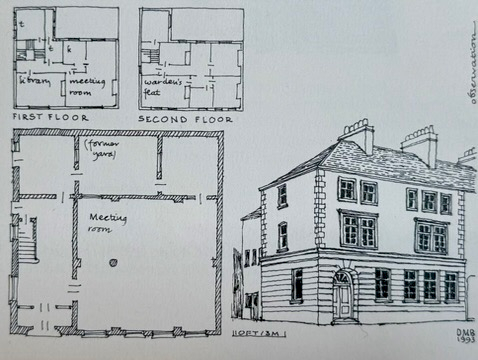
A plan of Hull Meeting House built in 1918. It was demolished in 1970.
Hull Quakers then used a Georgian House in Percy Street before moving to Bean Street.